Beyond the Crush-Resistant Pill: Engineering the Next Generation of Anti-Abuse Drug Delivery

Updated: Oct 23
By Sasha Stafford | Principal Scientist & Founder | Elixis Biosciences & Prodelic Technologies

For decades, the pharmaceutical industry’s approach to abuse deterrence has been largely reactive. When a therapeutic class demonstrates high abuse liability, formulation scientists are traditionally called in to build a physical fortress around the Active Pharmaceutical Ingredient (API).
If you understand chemistry as the ultimate control panel for human physiology, you also understand its central vulnerability: pharmacokinetic rate equals subjective reward. Whether an API is an opioid, a central nervous system (CNS) stimulant, or a novel neuroplastogen, its potential for misuse is rarely just a function of receptor affinity. It is driven by dC/dt—how rapidly the molecule crosses the blood-brain barrier to spike peak plasma concentration (Cmax) and compress the time to reach it (Tmax).
Today, as therapeutics expand into complex outpatient paradigms, first-generation "crush-resistant" tablets are no longer sufficient. Designing true anti-abuse architecture requires shifting from passive mechanical barriers to intrinsic, molecular, and device-level pharmacokinetic locks.
1. The Current State of Technology: How We Deter Abuse Today
To see where formulation science is going, we first have to quantify what current Abuse-Deterrent Formulations (ADFs) actually do. First- and second-generation ADFs were engineered primarily to stop mechanical tampering (crushing, grinding, chewing) and solvent extraction (dissolving a pill for intravenous injection or intranasal insufflation).
Currently approved commercial technologies rely on four foundational mechanisms:
ADF Mechanism | How It Works | Formulation & Physical Pharmacy Mechanics | Primary Vulnerability |
Physical & Rheological Barriers | Makes the pill rock-hard to crush and turns it into a thick, un-injectable gel if mixed with water. | High-molecular-weight polyethylene oxide (PEO) matrices cured via hot-melt extrusion (HME); rapid hydration forms high-viscosity hydrogels. | Does not prevent intact oral over-consumption ("pill-popping"); defeated by prolonged thermal or acid/base pre-treatment. |
Agonist / Antagonist Combinations | Hides a "blocker" drug inside the pill that only activates if the pill is crushed or dissolved. | Sequestration of an antagonist (e.g., naloxone or naltrexone) within hydrophobic multiparticulate cores that remain intact during normal gut transit. | Careful mechanical separation of beads or selective solvent extraction can isolate the active API. |
Aversive Agents | Adds an ingredient that causes intense nasal burning or flushing if snorted or taken in excess. | Incorporation of mucosal irritants (capsaicin, sodium lauryl sulfate) or vasodilators (niacin) released upon barrier disruption. | Low regulatory favorability due to off-target toxicity and poor patient compliance. |
First-Gen Prodrugs | The drug is chemically "locked" and completely inactive until stomach or gut enzymes unlock it. | Covalent conjugation of the API to an amino acid or ligand (e.g., lysine in lisdexamfetamine) requiring enzymatic cleavage by peptidases. | Linear enzymatic cleavage still allows supratherapeutic plasma levels if a patient swallows multiple intact doses. |
2. The Market Landscape: Why Capital is Flowing Back into ADFs
Between 2026 and 2034, the global Abuse-Deterrent Formulation market is projected to expand from roughly 3.88 billion – 6.80 billion to over 7.5 billion – 14.7 billion, growing at a steady 7.7% to 8.0% CAGR. Meanwhile, the broader advanced transdermal and transmucosal delivery market is scaling past $86.9 billion in 2026 toward $136.7 billion by 2030.
Three structural forces are driving this resurgence:
Expansion Beyond Opioids: While the FDA’s original 2015 ADF framework focused on opioids, regulatory scrutiny and clinical demand have shifted aggressively toward CNS stimulants (ADHD therapeutics), sedative-hypnotics, ketamine/dissociatives, and next-generation neuroplastogens.
The Shift from Inpatient to Outpatient Care: Healthcare economics cannot sustain multi-hour, in-clinic monitoring for emerging psychiatric and pain therapeutics. Payers are demanding take-home, outpatient delivery formats—which the FDA will only clear if the delivery vehicle makes diversion and supratherapeutic dosing physically or chemically impossible.
505(b)(2) Lifecycle & IP Extension: For biotech developers working with known or generic chemical entities, wrapping an API in a proprietary, non-obvious anti-abuse architecture creates defensible composition-of-matter and method-of-use patent moats while qualifying for streamlined regulatory pathways.
3. The Gaps: Why First-Generation Deterrence Fails
If you approach drug delivery from first principles, the flaws in current ADF technology become glaringly obvious. We have spent billions of dollars solving yesterday’s tampering methods while leaving the largest vectors of misuse wide open:
The "Intact Oral Overdose" Blind Spot: This is the elephant in the formulation room. A high-molecular-weight PEO tablet stops a user from snorting or injecting a drug, but it does nothing to stop someone from swallowing five intact pills at once. Once in the gastrointestinal tract, surface erosion proceeds in parallel across all five tablets, resulting in a lethal or euphoric spike.
The "Kitchen Chemistry" Arms Race: Polymeric barriers rely on physical entanglement. With readily available household solvents, microwave heating, pH manipulation, or mechanical coffee grinders, determined users routinely bypass physical matrices within weeks of a product hitting the market.
Manufacturing Complexity & Dose Dumping: Hot-melt extrusion and complex core-shell multiparticulates introduce severe Chemistry, Manufacturing, and Controls (CMC) headaches. Minor batch-to-batch variations in polymer curing or coating thickness can lead to catastrophic in vivo dose dumping—especially when co-ingested with alcohol—turning a sustained-release safety mechanism into an acute toxicity hazard.
Pharmacokinetic Variance: Oral delivery is inherently noisy. First-pass hepatic metabolism, gastric emptying rates, food effects, and gut pH variability mean that even a "perfect" oral ADF delivers wildly different plasma profiles across patients.
4. The Next 5 Years (2026–2031): Where the Technology is Going
Over the next five years, anti-abuse drug delivery will move away from "harder pills" toward self-regulating chemical and physical architectures. If a patient attempts to take too much, or attempts to extract the API, the delivery system itself neutralizes the reward curve.
A. Enzyme-Saturable "Ceiling" Prodrugs
First-generation prodrugs cleave linearly: take twice as much, get twice the active drug. Next-generation prodrugs are engineered around Michaelis-Menten enzymatic saturation. By conjugating the API to specific promoieties targeted only by low-capacity, location-specific mucosal or hepatic enzymes, the conversion rate hits a biological ceiling (Vmax). If a patient swallows ten doses, the target enzyme saturates; the excess prodrug cannot be cleaved and is safely excreted unchanged.
B. Stimuli-Responsive & Self-Inhibiting Hydrogels
Rather than relying on passive polymer viscosity, smart polymeric matrices are being formulated with pH-, ion-, and solvent-triggered crosslinkers. If exposed to non-physiological conditions—such as ethanol, organic solvents, extreme pH, or mechanical shear—the polymer network undergoes rapid, irreversible covalent or ionic crosslinking, trapping the API inside an insoluble glass or precipitating the drug as an unabsorbable salt complex.
C. Dissolving Hydrogel Microneedles with Zero-Order Kinetics
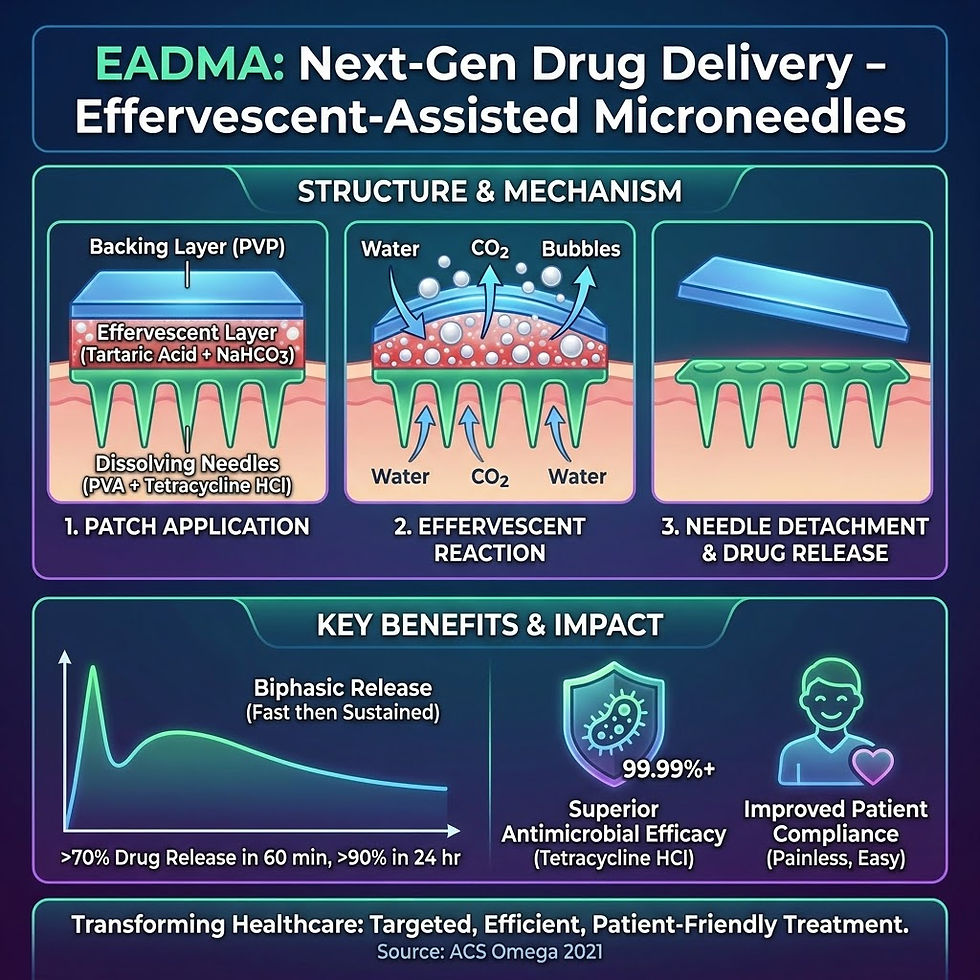
Moving potent CNS molecules out of the GI tract entirely is one of the most effective ways to eliminate both first-pass variance and oral over-ingestion. Biodegradable dissolving microneedle patches (utilizing tunable polymers like GelMA or PVA/PVP blends) painlessly breach the stratum corneum to deposit drug-loaded micro-depots directly into the dermis.
Once applied, the needles dissolve immediately—meaning the patch cannot be removed and scraped for free API.
Polymer degradation is tuned to strict zero-order release kinetics, flattening the Cmax spike so the molecule delivers therapeutic efficacy without crossing the threshold into euphoria.
D. Hardware-Enforced & Micro-Metered Delivery Systems
For ultra-potent, fast-acting transmucosal or intranasal therapeutics (such as Self-Nanoemulsifying Drug Delivery Systems, or SNEDDS), physical formulation is merging with dose-limiting micro-hardware. Lockout-enabled nasal actuators and biometric-verified buccal dispensers physically restrict actuation intervals, preventing stacked dosing while maintaining sterile, preservative-free unit stability.
5. Partnering with Elixis Biosciences: Custom Biomaterial & Matrix Engineering for Your API
At Elixis Biosciences, we recognize that effective delivery architecture is never one-size-fits-all. An anti-abuse or controlled-release matrix must be custom-engineered around the exact physicochemical constraints of your Active Pharmaceutical Ingredient—accounting for solubility, surfactant load, mucosal residence time, and rigorous USP stability standards.
We specialize in translating complex APIs into scalable, CMO-ready formulations. By combining advanced polymer chemistry, micro-emulsified systems, and targeted hydrogel matrices, Elixis Biosciences helps B2B partners design bespoke delivery vehicles that protect patient safety, prevent dose-dumping, and establish robust intellectual property. If you are developing a therapeutic that requires precise pharmacokinetic control and tamper-resistant biomaterials, reach out to our team to discuss custom formulation design.