The 60-Second Revolution in Drug Delivery: How Effervescent Microneedles Solve the Patient Compliance Dilemma

By Sasha Stafford | Principal Scientist and Founder | Elixis Biosciences
Published: September 2026
The Silent Breakdown of Modern Pharmacotherapy
We often evaluate clinical therapeutics through the lens of molecular efficacy: how tightly an antibody binds its target, how potently a small molecule inhibits an enzyme, or how low an antibiotic’s Minimum Inhibitory Concentration (MIC) is. Yet, in real-world clinical practice, therapeutic success hinges on a far more fragile variable: patient compliance.
Whether it is the dread of hypodermic needles, the systemic gastrointestinal toll of broad-spectrum oral antibiotics, or the inconvenience of wearing adhesive patches for hours, the gap between prescribed medicine and administered medicine remains one of the largest cost drivers and sources of morbidity in modern healthcare.
A recent breakthrough published in ACS Omega—“Effervescent-Assisted Dissolving Microneedle Array Patches for Localized Tetracycline Delivery” (ACS Omega 2026, 11(6), 10814–10827)—presents a brilliant bioengineering leap that tackles this exact friction point. By integrating an effervescent separation mechanism into a three-layer dissolving microneedle patch, researchers have reduced transdermal patch application time from hours to just 60 seconds, unlocking a transformative paradigm for painless, targeted therapeutics.

The Challenge with Conventional Dissolving Microneedles
Dissolving microneedle array patches (DMNAPs) have long held enormous promise in biotechnology:
⚬ They penetrate only the stratum corneum and superficial epidermis, avoiding the deeper dermal nerve endings (making them virtually painless).
⚬ They bypass first-pass hepatic metabolism, avoiding premature drug breakdown.
⚬ They dissolve entirely inside the tissue, leaving zero sharps waste behind.
However, standard dissolving microneedles suffer from a major operational limitation: wear time.
In conventional systems, the microneedles are tethered to the backing film. For the payload to fully dissolve and release into the skin’s interstitial fluid (ISF), the patient must keep the adhesive patch pressed against the skin for extended periods—often several hours. In real life, long wear times trigger a cascade of user failures:
1. Patches slip or peel due to sweat, movement, or clothing friction.
2. Adhesive wear causes localized erythema and irritation.
3. Needle tips can prematurely back out, leading to variable and under-dosed drug delivery.
The Innovation: A Three-Layer Effervescent Architecture

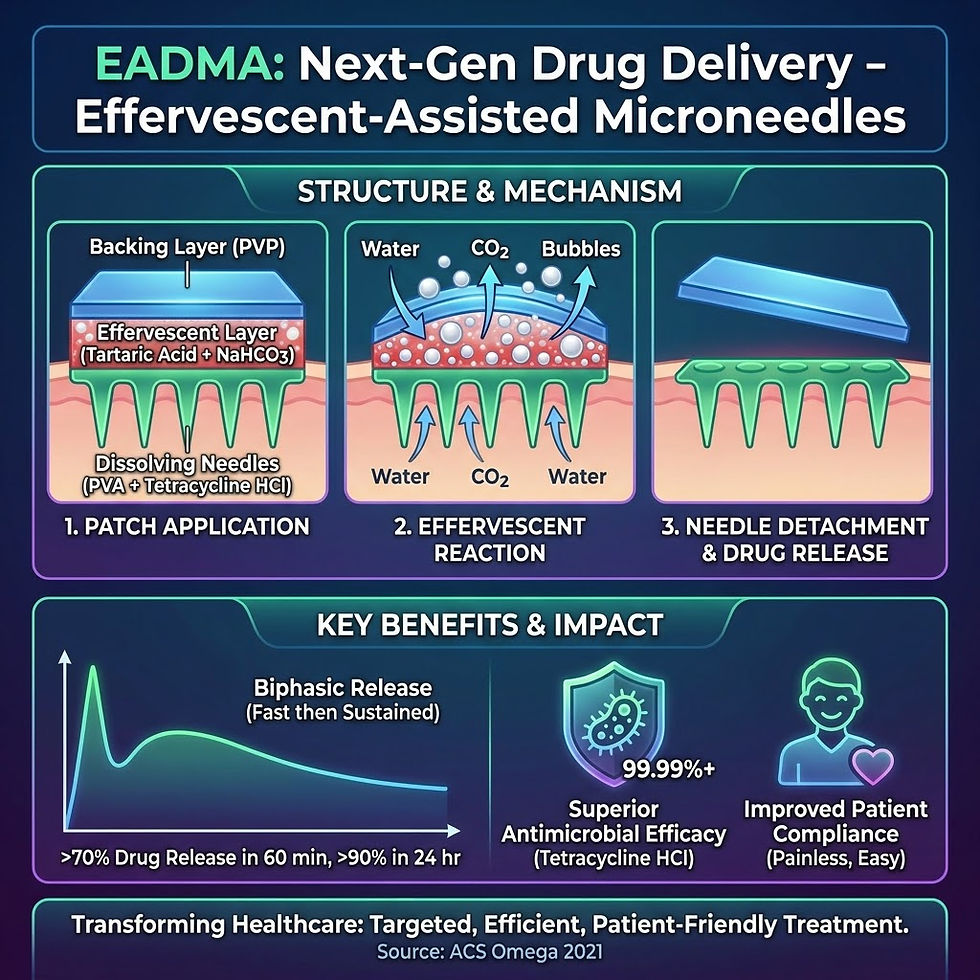
To eliminate the wear-time barrier, the authors engineered a precision three-tier dissolving array using sequential casting:
1. Structural Backing: Polyvinylpyrrolidone (PVP)
2. Effervescent Layer: Sodium Bicarbonate + Tartaric Acid
3. Drug Array: PVA Microneedles loaded with Tetracycline

1. The Therapeutic Needles: Conical microneedles made of water-soluble poly(vinyl alcohol) (PVA) loaded with tetracycline hydrochloride (TCH).
2. The Reactionary Separation Interlayer: A micro-formulation containing sodium bicarbonate and tartaric acid.
3. The Mechanical Backing: A flexible polyvinylpyrrolidone (PVP) layer designed for easy handling and structural stability.
The 60-Second Chemistry
When the patch is pressed into the skin (achieving a penetration depth of 426 micron with a 96% penetration efficiency), the minute quantity of moisture from the dermal interstitial fluid enters the array.
The fluid instantly triggers an acid-base neutralization between the tartaric acid and sodium bicarbonate:
The rapid, localized generation of microscopic carbon dioxide (CO2) bubbles creates a gentle mechanical cleavage plane. Within 60 seconds, the microneedle tips detach cleanly from the patch backing.
The patient simply presses the patch for one minute, peels off the backing, and throws it into ordinary waste. The microscopic, drug-laden PVA needles stay safely deposited beneath the stratum corneum, continuing to dissolve and release their payload autonomously.
Redefining Patient Compliance: Why This Changes Everything
At Elixis Biosciences, we closely track innovations that bridge molecular discovery and human behavior. The clinical implications of rapid-release transdermal delivery are profound:
1. Eradicating Trypanophobia (Needle Phobia)
Between 10% and 20% of adults experience needle anxiety significant enough to cause delayed medical care, missed vaccinations, or non-adherence to injectable regimens. Because these arrays do not reach pain-sensing nociceptors, administration feels no more invasive than pressing a piece of tape to the skin.
2. From "Chronic Wear" to "Press and Go"
Removing the need to wear an adhesive patch for hours transforms compliance from an active, precarious chore into a negligible 60-second routine. There is no risk of the patch dislodging under a shirt, peeling during exercise, or falling off while sleeping.
3. True Self-Administration
Complex injectables require clinic visits or trained caregivers. The simplicity of a 60-second peel-and-press system allows non-specialist patients—including elderly individuals or those with reduced fine motor skills—to reliably administer therapy in the comfort of their home.
Clinical & Public Health Impact: Localized Potency vs. Systemic Toxicity
The study evaluated the platform using tetracycline against common superficial skin infections, including Staphylococcus aureus and Escherichia coli. The pharmacological profile demonstrated key advantages that extend far beyond dermatology:
A Biphasic Release Profile

The PVA matrix delivers a dual-phase kinetic profile:
⚬ Immediate Burst: Over 70% of the active payload is released within 60 minutes, quickly saturating the infected area and suppressing pathogen replication.
⚬ Sustained Eradication: The remaining payload delivers sustained therapeutic concentrations over 24 hours, exceeding the minimum bactericidal concentration and preventing bacterial resurgence.
The array achieved a >99.99% bacterial reduction within 6 hours (at concentrations exceeding 4X) while maintaining human dermal fibroblast viability above 82%.
Combatting Antimicrobial Resistance (AMR)
Systemic antibiotic therapies—oral capsules and intravenous infusions—carpet-bomb the host system. They decimate the gut microbiome, burden hepatic and renal clearance pathways, and expose off-target bacteria throughout the body to sub-lethal drug levels, which acts as a primary incubator for antimicrobial resistance.
Localized transdermal delivery reverses this dynamic:
⚬ It concentrates ultra-high drug levels directly at the nidus of infection.
⚬ It minimizes systemic bioavailability, protecting the gut microflora and preventing systemic side effects.
⚬ It ensures full treatment completion, counteracting the common issue of patients stopping their antibiotic pills early once visible symptoms subside.
Beyond Antibiotics: What Lies Ahead
While this study focused on localized antimicrobial delivery, the underlying delivery mechanism—effervescent gas-mediated rapid separation—is a modular platform technology.
At Elixis Biosciences, we see immediate translational horizons across several therapeutic classes:
⚬ Macromolecules & Biologics: Delivering peptides, GLP-1 analogs, or monoclonal fragments transdermally without cold-chain storage or syringes.
⚬ Rapid-Response Emergency Therapeutics: Fast transdermal delivery of acute rescue medications (e.g., migraine abortives, naloxone, antiemetics) where intravenous access is unavailable.
⚬ Vaccine Delivery: Enhancing intradermal antigen presentation by targeting Langerhans and dendritic cell networks within minutes, bypassing hypodermic waste and trained medical personnel.
Conclusion
The future of biotechnology is not solely about creating more potent molecules; it is about creating delivery architectures that integrate seamlessly into human lives.
By marrying clever micro-scale chemistry with functional biomaterials, the effervescent microneedle array eliminates the friction that has held transdermal patches back. A one-minute application that delivers 24-hour therapeutic power represents the kind of patient-centric design that will turn life-saving biology into real-world health outcomes.


Comments